-
These days I use water soluble paints for most of the weathering tasks -- the ease of use, quick drying (a heat-gun is your friend), and availability of the stuff makes it extremely user-friendly. Though easily abraded, it's all protected by the final 2K polyurethane, well flattened, clear coat.
For water-based paints (acrylic and latex are but two examples of coatings that employ water as a solvent), or any chemistry of paint: if you cut it with too much solvent/thinner, you reduce the 'binder content (the 'glue' that sticks the paint to the substrate) to the extent that its adhesive and binding qualities are compromised. That's why -- when extensively cutting the coating with solvent -- you have to increase the binder content as well.
Keep in mind that I also added the 'clear' Artist Medium (binder) to that particular batch of paint to make the coating semi-opaque, not opaque as it would be out of the bottle. The objective was to get the uneven tan color to highlight but not obscure the dark gray and splotching underneath.
Something to know: Other than watercolors and some inks, water soluble paints are water resistant once thoroughly dry.
DavidLeave a comment:
-
David when you outlined "The initial representation of marine grass done, I mixed up the tan acrylic paint with a lot of water solvent. Doing so thinned the paint to the point where its adhesive quality was dangerously low. To increase the binder content of the paint I added clear acrylic medium to restore the sticking power of the paint." am I correct you mixed the Tan paint with water? Why is water better then mixing with thinner or just the clear acrylic medium?
Leave a comment:
-
-
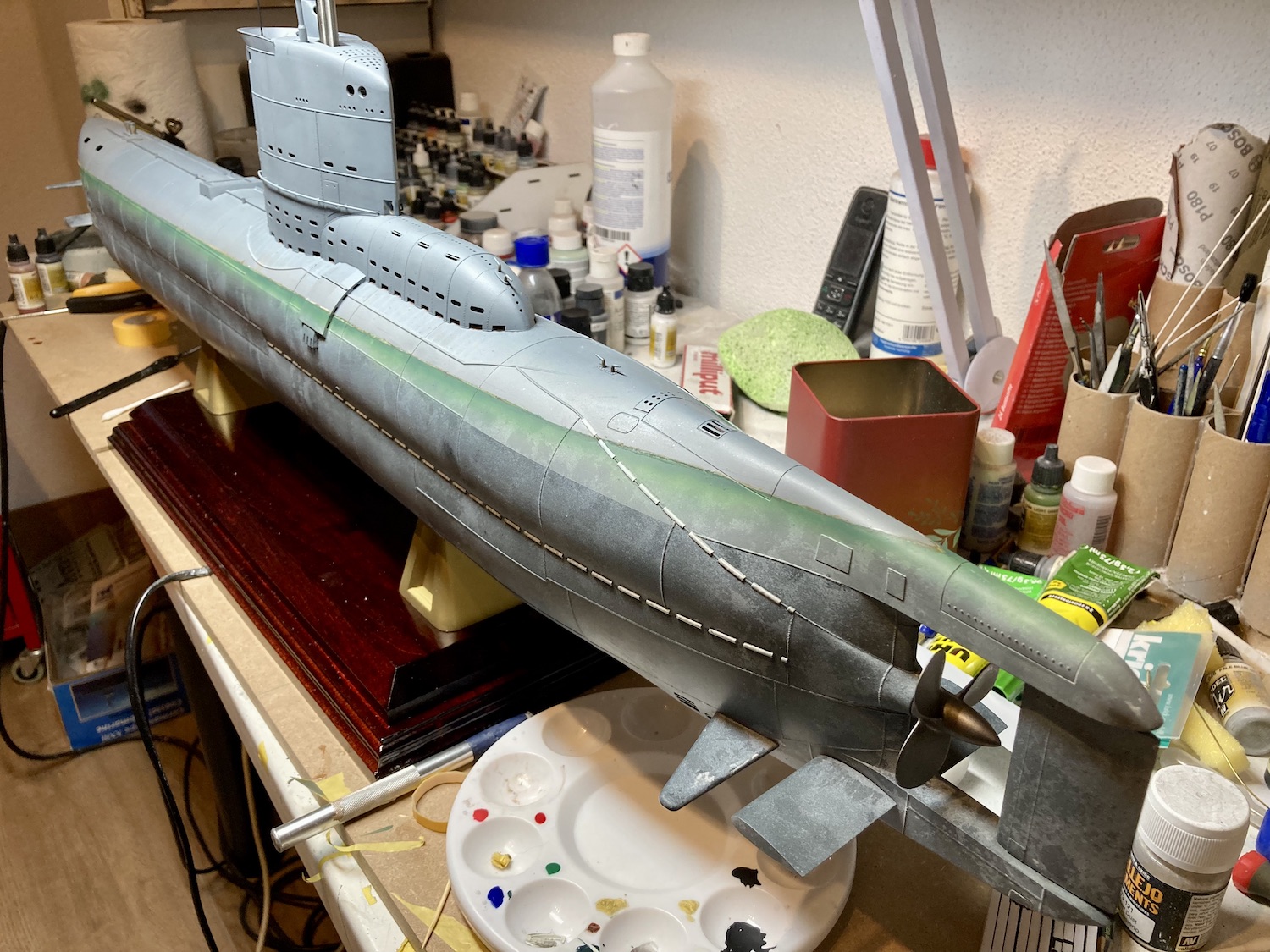
I should have. But I missed that subtle point. In my defense: these boats spent more time against a pier in proper surface trim than they did underway -- and a significant portion of that underway time was submerged, hanging off the snorkel. The only time these 'electro boats' were underway on the surface -- and the ass end weighted down so the propeller would be less susceptible of sucking air when pulled through a trough -- would be too and from the patrol area. Chaotic water does not a scum-line permit.
But I do like the good Doctors representation of the demarcation line 'as designed' and the suggestion of an underway scum-line at the stern. A reasonable presentation of how these boats were trimmed for transits.
DavidLeave a comment:
-
-
-
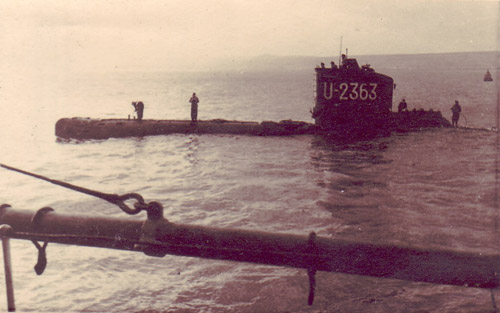
In my XXIII build, The water line and the separation of the dark and light gray do not coincide. In most pictures the stern is submerged when the boat is surfaced.
Last edited by DrSchmidt; 01-07-2024, 04:05 AM.Leave a comment:
-
Southeast CT. Only a few miles from Subase, Groton. ALL the water around here has oak leaves in it!!!!Leave a comment:
-
Cool 1:144 Type XXIII model build and painting
Leave a comment:




Leave a comment: