-
Thanks David and I'm pretty sure it will.Since my previous post I had it out a couple of times with some quirks happening on the first run. It started the whole porpoising thing... Back on the bench I went through the gamet of tests starting with a good check of the planes for free movement then the the receiver and battery follwed by the adf and its functions and zero bubble recalabration. There was always some clutching on the servo for the rear planes but adjusting the sensitivity usually fixed that... But not this time. It turned out the servo for the rear planes went bad!! It was erratic and then wouldn't throw left and with each attempt it had a fit. So out it came and it was rather hot to touch to boot. Replaced it, retested everything then turned it off. Came back later turned it on and tested it all again readying it and recharging the batteries for last Sundays run. which except for the rain was beaut!http://static.photobucket.com/player...ps4e1998c0.mp4I took this with my mobile so apologies for the picture.Last edited by alad61; 07-30-2013, 12:30 AM. -
THAT'S the way it should be. Congratualtions, Alec. May it give you pleasure for decades.
MLeave a comment:
-
Thanks Tom. Once I established the best revs for the motor it practicaly drove itself. All I pretty much had to do was attend the rudder and follow the wake from the masts.:biggrin:Originally posted by troutLeave a comment:
-
John as my boat was bobbing around like a dolphin/kangaroo mutation with an unbalanced trim as well as the excessive torque rolls when trying to run it at 100% motor power Scuba Divingthe float in the sail wasn't getting time to do its thing The Titanicresulting in more water than normal getting in the induction lines. Yet even so the system still brought the boat back to a surface stance that let me control it back to the dock. Due to my own inadequacies or simple errors the system still worked And Sunday proved that when you get it all right the SAS system is better than good. I have another Gato model in transit from over seas so it will be going the SAS too :wink:Leave a comment:
-
-
Yes, with the SAS ballast sub-system you'll see condensation forming on the inside of the cylinder, over where the safety float-valve discharges/take on air within the cylinder. There is always water droplets sucked into the induction line once the snorkel head-valve opens upon broaching the sail. That moist air enters the interior of the SD through the safety float-valve, if there is a slight vacuum within the SD -- and that moist air hits the cold inside of the cylinder and condenses into 'fog' or even water droplets. No biggie. The safety float-valve is there to catch and stop an in-rush of water -- a broken or not made up snorkel induction hose -- not moist air.
DavidLeave a comment:
-
What if you make a bend in the induction line that is higher than the inlet valve opening to limit any water ingestion like on these
narco-semesubmersibles exhaust.
Leave a comment:
-
Alec,
I can understand your other leaks, but the induction line if it has water inside it should not be leaking into the SD at all as the safety valve should be catching that.
David,
I take it the condensation that Alec is talking about would be normal - if the there is water in the induction line and the safety valve is working? Should we expect any condensation with SAS?
Thanks
JohnLeave a comment:
-
That ran great! You have really good control of it. When I first saw the posting, I was staring at the "picture" trying to see your sub - then started to chuckle when I thought of someone's tag "why are you staring at the empty pond" (something close to that).Leave a comment:
-
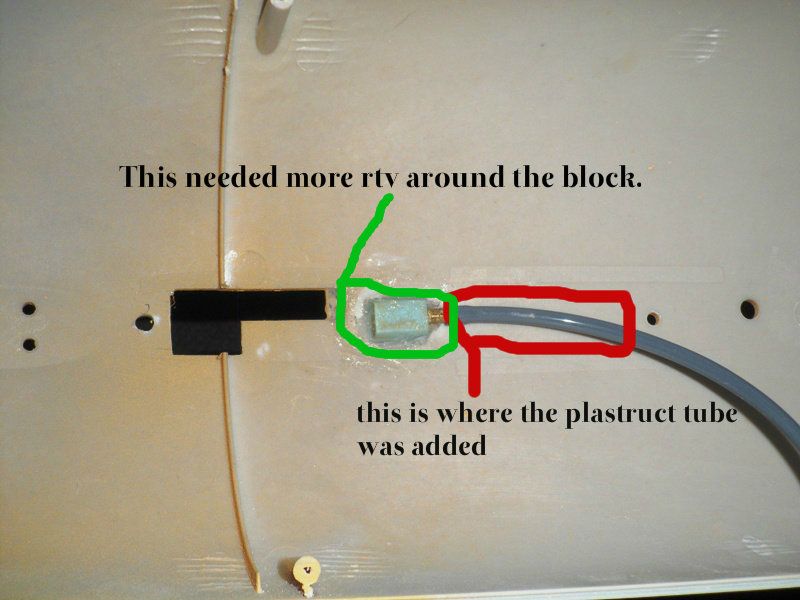
John in the beginning I believe I had seal issues from the induction tube in the sail to the induction elbow on the inside beneath the sail. I also know for certain that the switch leaked like a dripping tap when the SAS was drawing air from just the SD. The initial set up of the elbow block was without a stress relief point on the line out of it. A small piece of styrene tube and gluing the elbow block with thick ca an backing soda quickly sanded off before it fully cured solved a big water ingress issue. I must stress that it may well have been my initial assembly though.
Also running the boat at out of scale speeds causing excessive porpoising, pitching and rolling would have been the cause of some water making its way into the induction line.
Today was a different story!!! I spent the better part of almost two hours with the sub in the water running it with a full ballast. Once I worked out the best speed to drive it at all I had to do was thumb the rudder stick most of the time with only a little movement on the planes to drive it below periscope depth. I used the SAS at least twice to raise it and check the trim when opening the vent valve and the only signs of water in the SD were some fogging near the safety float valve... Apologies for the look of the video and the glare flashes. Between our morning winter sun and an incorrect exposure setting on the camera the video isn't the best. This was towards the end of the mission where I was feeling very comfortable with how it ran submerged after a good deal of time with it operating near the dock just in case something went against the plan.

Leave a comment:
-
As I await my 2 news SAS subdrivers, can't help but think re the size of the float valve on the head valve that I will inevitably have to build / modify it for inclusion in the 1/72 Permit sale (around half or a bit less than the real estate of the Skipjack).
Am toying with the idea of using a tyre valve (same as we use on the Subdrivers to vent overpressure on closure), but with spring removed and an actuation by smaller float. Other idea is to use a small Oring lining the pipe and atop the float having a small ball (like that used in the torpedo system), to form a male female fit.
Of course I'll try David's way first but am also wondering about getting the open/close activation point a bit higher up. Currently the LPB / gas system affords the full length of the scale snorkel, whereas SAS activates a closed head valve just beyond deck's awash. Any suggestions?
I note also the Permit's design plonked snorkel as the forward most mast, that is forward of the sail control area and unpopular with crews conning the boat up there when surfaced. Perhaps this snorkel unit with its head top fitting can be made to work in scale?
Cheers
JohnLeave a comment:
-
Alec,
interested to know the source of the leak you had?
Was it SAS related or some other seal issue?
Also if you had water in the SAS induction line did the boat still surface using SD air ok?
Thanks
JohnLeave a comment:
-
Sure. No sweat. Without challenge there is no progress/knowledge/clarification.
MLeave a comment:
-
Thank you David,
You say a squirt of MP air. To me, this is the gas system from the on-board bottle.
This chapter explains the system. http://www.maritime.org/fleetsub/air/chap1.htm#1A
Without the on-board gas system you are not emulating the real thing! Dah
I hope you are still my Friend?Leave a comment:
-
Dsvid,
You stated "The SAS very much emulates the design and function of 'real' submarine ballast systems.
Please see the attached page which clearly shows that the ballast tanks on our fleet boats were blown from the high pressur air systm taken from the 3000 psi manifold reduced to 600, 500, or 225 psi where necessary for different operations.
http://www.maritime.org/fleetsub/air...ut/fig2-01.htm
Regards,
The s--t stirrer
Only in extremis.
Normal blow was to squirt some MP air into the bow buoyancy tank, start the low pressure blower (taking a suction on the boats air) and discharging into the main ballast tanks, popping open the main induction soon as the fairwater broaches, and ventilate the boat. Pretty much the system Manfred came up with.
MLast edited by He Who Shall Not Be Named; 06-21-2013, 11:03 PM.Leave a comment:


Leave a comment: